Legal Atlas®
 CyberTracker and SMART Mobile support Legal Atlas® map packages. These packages contain polygons and metadata used to identify which laws may apply in a particular location.
Disclaimer: Legal Atlas® content is provided for informational purposes only and does not constitute legal advice. Government authorities are the authoritative source of all laws and regulations. Always consult official government sources or qualified legal counsel for definitive legal guidance.
Packages
The legal data currently available is limited to Mongolia. This dataset has been developed in partnership with Legal Atlas®, Wildlife Conservation Society, and the SMART Partnership to support ranger operations and legal awareness in the field.
Download Mongolia package (English)
Download Mongolia package (Mongolian)
Setup
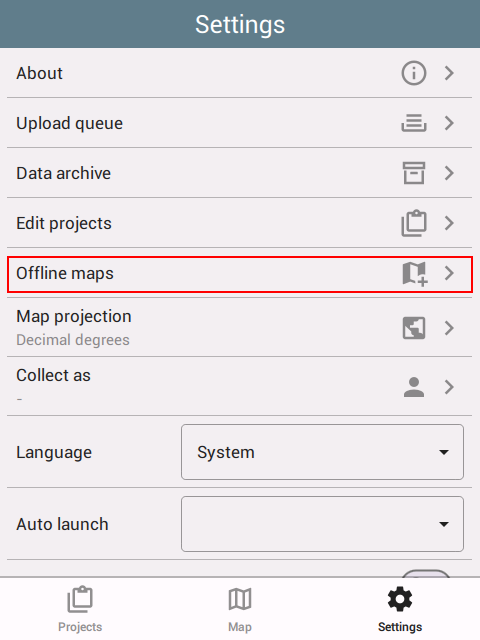
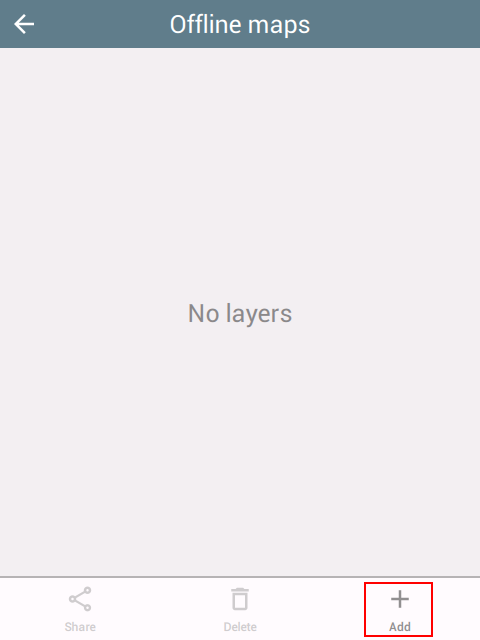
CyberTracker and SMART Mobile can load a Legal Atlas® map package (a zip file) directly. Copy it to your device, then go to the Settings page and select Offline maps to add it. SMART Mobile also supports adding a Legal Atlas map package as an offline map layer.
 |  |
Selecting a lookup location
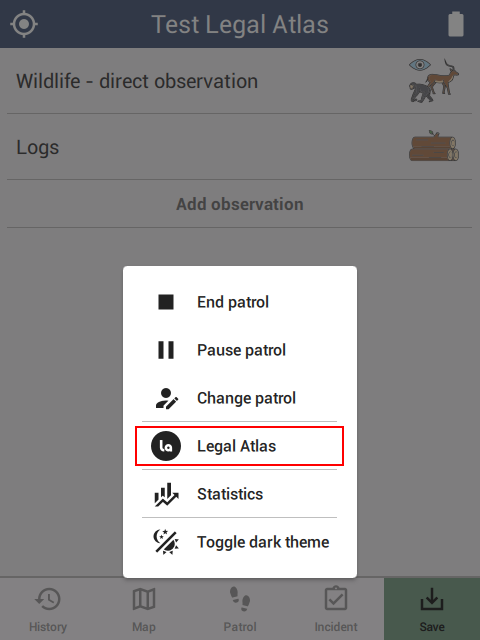
Legal Atlas functionality is only available when Legal Atlas offline map layers are loaded. There are three ways to trigger a lookup:
 |  |  |
-
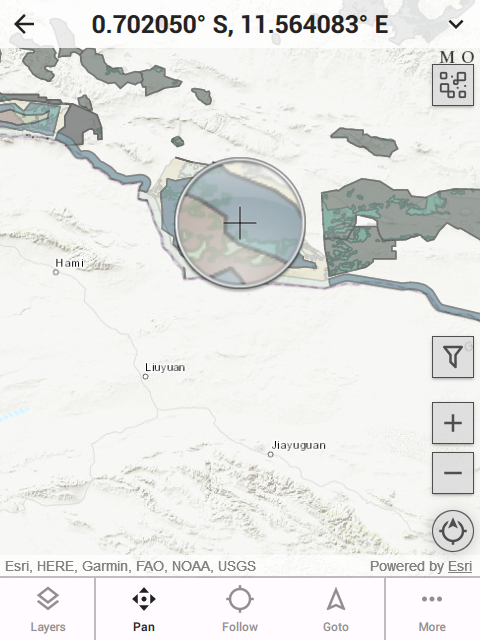
Long press on the map — A magnifying glass appears after a long press, allowing you to specify a precise location for the lookup.
-
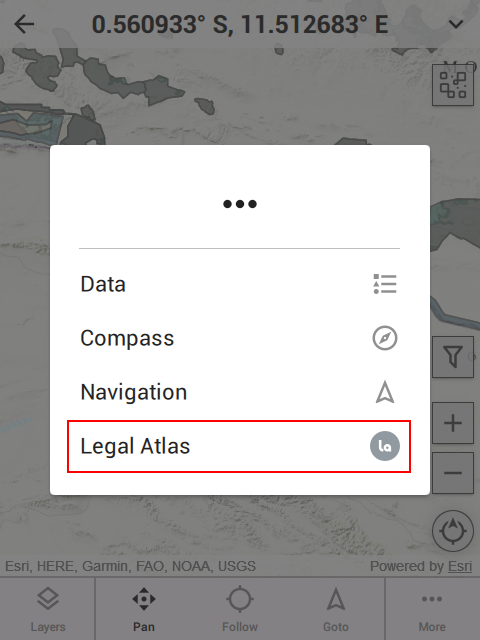
Menu button — Tap the
...button in the lower right corner of the map page and select “Legal Atlas” from the popup. This uses the current location for the lookup. -
SMART patrol or survey — During a patrol or survey, the control popup includes a “Legal Atlas” button. This performs a lookup on the last known location, which is typically the current location.
Navigating content
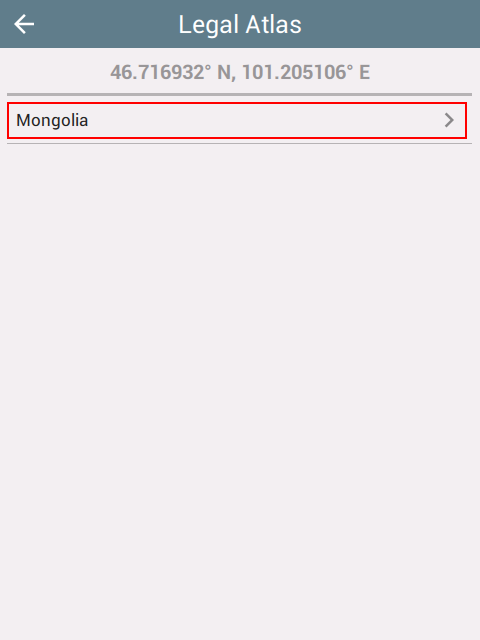
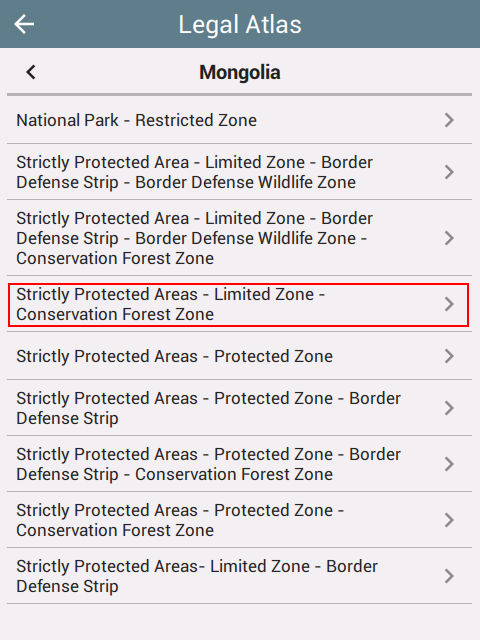
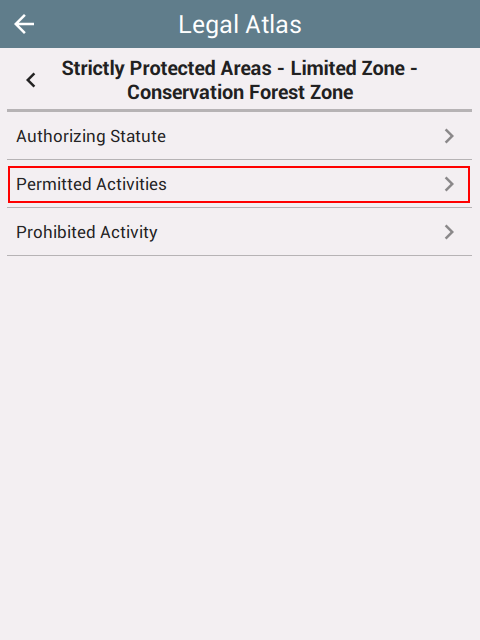
After selecting a lookup location, a navigation page appears. Select list items to browse through the legal content.
 |  |  |
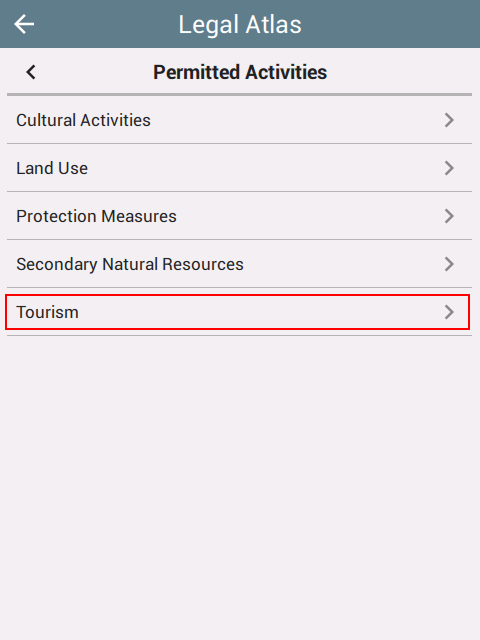 | 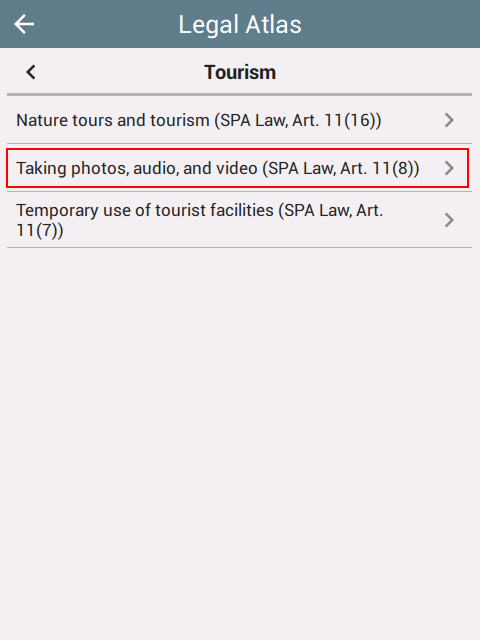 | 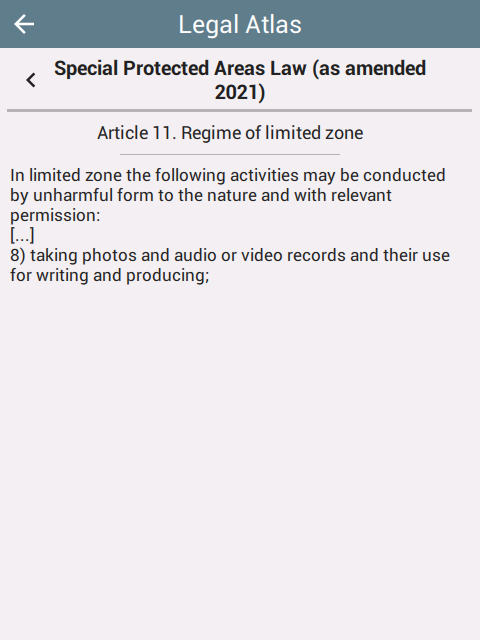 |
Note:
- Pressing the top-left back button returns to the prior page.
- Pressing the back button on the title bar navigates to the prior lookup page.
Legal Atlas® platform
Legal Atlas® is an independent legal intelligence organization that converts laws and regulations into structured, georeferenced datasets for a variety of uses, including conservation and enforcement technologies. Legal provisions are mapped to national and sub-national jurisdictions and, through funded partnerships, can be further referenced to defined legal geographies that support deep analytics and operational decision-making. Geographic coverage expands based on project funding and partner priorities.
The information in the SMART application is also available on the Legal Atlas® platform. Access requires a free Legal Atlas® account. After logging in, users must take a few specific steps to view the data:
- Select the Legal Geographies topic within Legal Atlas®.
- Choose Mongolia as the country.
- Enable the relevant map layers using the map control panel.
- Right-click on the map and select Show tag details to view applicable legal information for a specific location.
These steps are required to ensure that the correct legal data layers are displayed and interactive. The process will be refined over time to improve usability and direct access. Contact us at info@legal-atlas.net if you have questions or need assistance.
Legal Geographies
Legal geographies are spatial representations of how laws apply across geographic space, translating legal provisions from narrative text into mapped areas that define the geographic conditions under which specific legal rules operate. A single location may be subject to multiple, overlapping legal geographies—such as administrative jurisdictions, protected area boundaries, species-specific regulations, or land-use zones—each carrying different legal implications.
The Legal Atlas® platform is designed to make this complexity operational by filtering legal data on a tightly defined, geo-referenced basis. For enforcement personnel, this enables identification of which legal provisions apply at a specific place, supports lawful decision-making in the field, and allows legal context to be integrated directly into operational tools such as SMART.